- perfectholidaytravel@hotmail.com
- +91 9811138106 / 9811 5939 89

Pushkar Festival
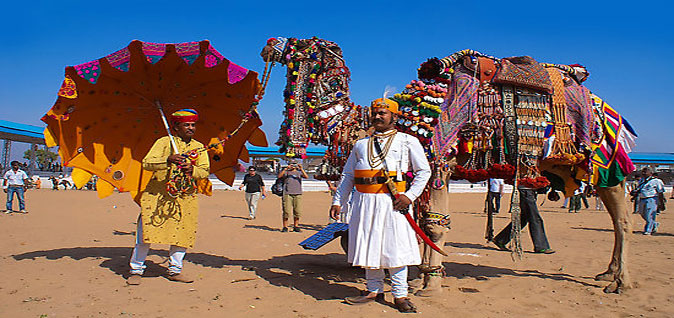
Easily the most easily indentifiable of Rajasthan's many fairs, Pushkar has come to symbolise the febrile heartbeat of the people of the state. Held in November in Pushkar, the temple town close to Ajmer, where an 8thcentury temple of Brahma drawns the faithful, it is located on the banks of a lake. Pilgrims bathe at the ghats and pary at the temple, while the actual fair is held in the vast stretching, desert around it, here traders sed camp to strike deals at India's and probably the world's largest camel fair, though horses also also sold, It is also a time for frineds and families to get together, camp in the desert entertain each other with folk songs adn dances, cook meals over camp fires, and wander through the exuberant melle of people looking for handcrafs. merely to stand in a queue for the giant wheel special tented camps are set up on the occasion for visitors but such is the draw of this fair internationallly, that even these are soon exhausted and people may have to stay in nearby Ajmer.
The festivity advances to the open sandspreads of the Polo Grounds, followed by camel races, camel milking, fur cutting design, the best breed competition, camel acrobatics, camel bands and watching all this, are the gaping spectators. The camel display amazing foot-work, dancing gracefully to the slightest direction of their riders.
Colourful bridles, bejeweled necks, jingling anklets and long, lanky camel shadows on dusky sands, cast a magic spell. The jubilant, skirt-swirling Gair dancers, the awe inspiring Fire dance, and dazzling fire-works light up the fortified desert city of Bikaner.
According to mythology, he performed the 'Yajna' at Jyeshtha Pushkar from Kartik Shukla Ekadashi to Purnima. Lakhs of devotees assemble and bathe in the holy waters during this period of the year; but bathing on the last day which is the full moon (Purnima) day, confers special blessings.
One of the major attractions in Pushkar is the Pushkar Fair the cattle fair is held here on this occasion, where other animals like camels and horses are also bought and sold. It is attended by people from far and wide.
This lake soon become a favourite resort of pilgrims, and during the midlle Ags temples and cenotaphs. Gradually quite a town of relegious buildings sprang up, peopled by Brahmins. The wealthy pilgrims from all parts of India brought untold riches to Pushkar, and the princes spared no expense to enrich the holy inhabitations of the sacred town. Padma Purana, elaborately describes the origin and importance of this lake. It says that Brahma, the Creator of the Universe, was once contemplating to locate a suitable spot on earth to perform a 'Yajna' (sacrificial ritual), the lotus fell from his hand and rebounding, struck the earth at three places within a circuit of kms. Water issued forth, from all the three places and the Creator called all the three as Pushkar (lotus) distinguishing them as 'Jyeshtha' (elder), 'Madhya' (central) and 'Kanishtha' (younger).